Reformer Pilates: What the Machine Does, How a First Class Runs, and How It Compares to Mat Pilates

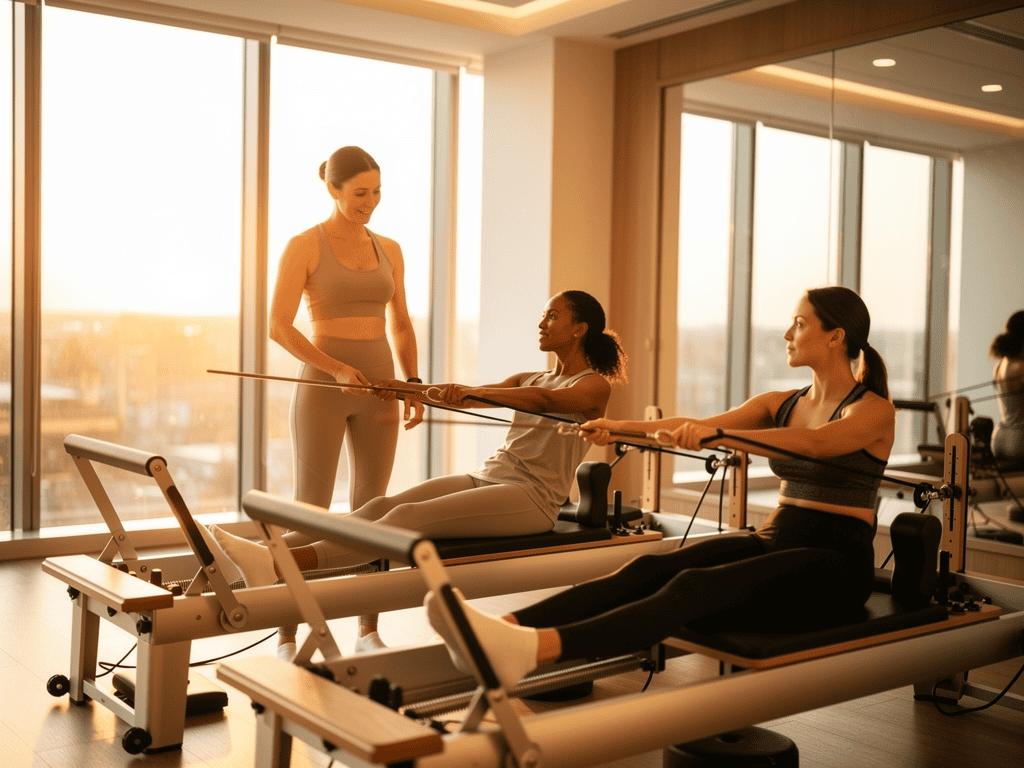
Same method, same exercises, two different ways of loading them. The mat uses your body weight. The reformer uses springs, which can make a movement harder or easier, and that second part is the thing almost nobody explains.
Mat Pilates vs Reformer: All You Need to Know
Here is the full comparison, what actually happens in a reformer class, and the kit for both.
Mat Pilates vs Reformer Pilates: Direct Comparison
Deciding between floor work and machine work comes down to resistance mechanics, body feedback, and practical routine requirements.
| Feature | Mat Pilates | Reformer Pilates |
|---|---|---|
| Where resistance comes from | Body weight and gravity acting against the floor. | Adjustable steel springs and sliding carriage tension. |
| What springs do that gravity cannot | Gravity pulls only downward in a vertical direction. | Springs provide progressive resistance across horizontal and diagonal planes, assisting or loading movement. |
| Difficulty for beginners | Higher initial barrier to entry for core recruitment without support. | Lower barrier to correct form because the carriage and straps physically assist alignment. |
| Difficulty for strong practitioners | Challenging through leverage and balance, but limited in external load. | Infinitely scalable by altering spring tension, unstable carriage holds, and speed. |
| Core demand | Requires constant self-stabilization against the static floor. | Requires continuous core bracing against an unstable, gliding surface. |
| Where it can be practiced | Anywhere with sufficient floor space for an exercise mat. | Dedicated movement studios or spaces equipped with an apparatus. |
| Cost to start | Minimal investment requiring only a supportive mat. | Higher investment due to specialized studio equipment or machine purchase. |
| Best suited for | Practitioners seeking foundational body awareness and complete mobility. | Practitioners needing guided joint decompression, varied loads, or tactile alignment cues. |
| Honest drawback | Easy to compensate with improper form without realizing it. | Requires specialized hardware, regular maintenance, or studio access. |
At-Home Reformer Pilates Machines
Investing in a home apparatus allows consistent progression without recurring studio bookings.
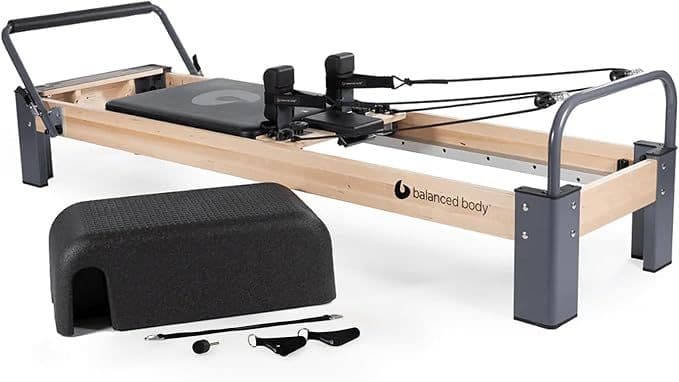
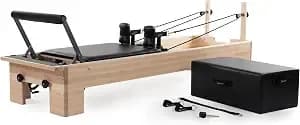
Balanced Body Rialto Reformer: Features a Sitting Box Lite, engineered carriage over rails, durable springs, and footbar setup designed specifically for home spaces.
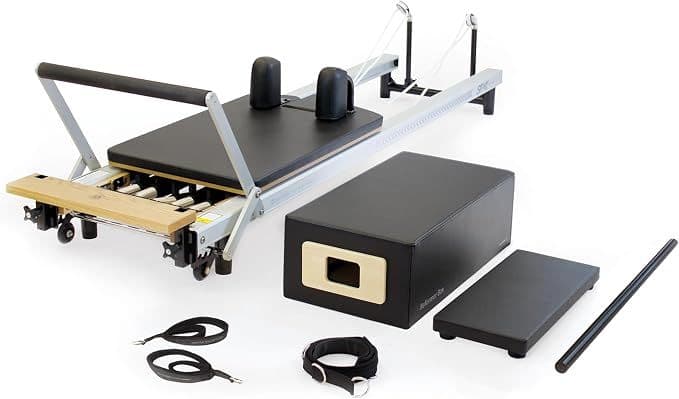
Merrithew At Home SPX Reformer Package: The home edition from STOTT PILATES with precision gearbar adjustments, sliding carriage on rails, and studio-grade components.
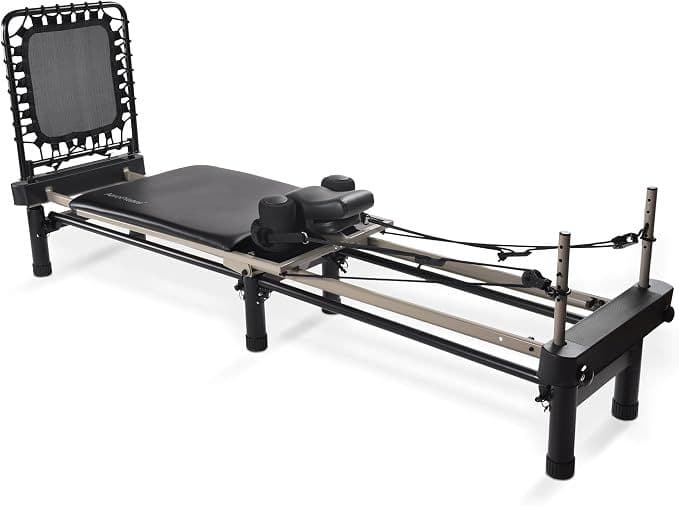
AeroPilates Premier Studio 700: A foldable frame design using cord resistance instead of traditional springs, offering an accessible entry point that stores easily.
Balanced Body Studio Reformer with Revo Footbar: Full commercial-spec apparatus featuring classic hardwood rails, adaptable footbar mechanics, and smooth carriage glide.
Disclosure: Holisteek may earn an affiliate commission from qualifying purchases through links on this page.
The Mat Kit Essentials
A focused home mat practice relies on dense cushioning and targeted props rather than heavy machinery.
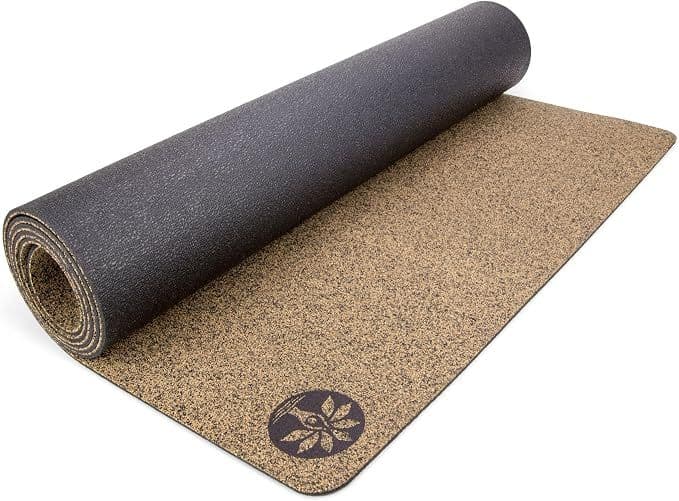
Yoloha Unity Cork 6.5mm Mat: High-density cork mat with 6.5mm thickness protecting the spine during floor roll-downs and articulation drills.
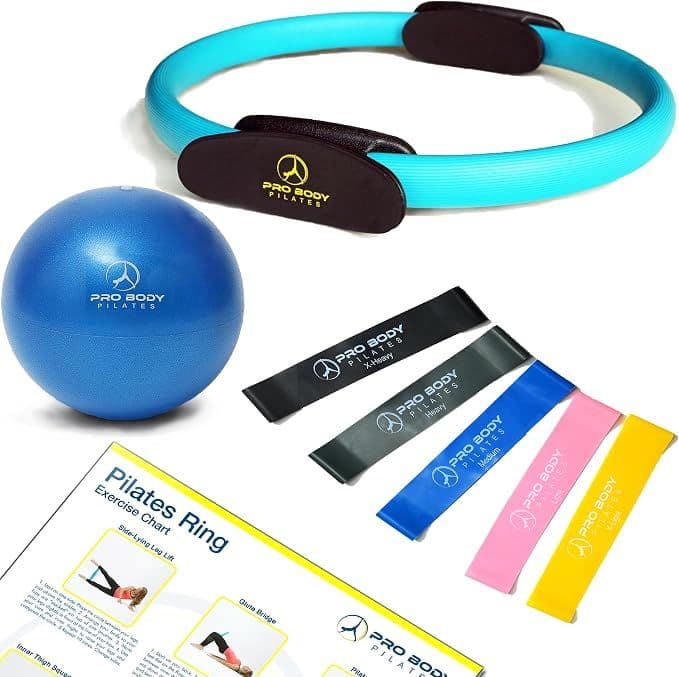
ProBody Pilates Home Workout Bundle: A three-piece training kit featuring a magic circle, 9-inch mini stability ball, and resistance bands.
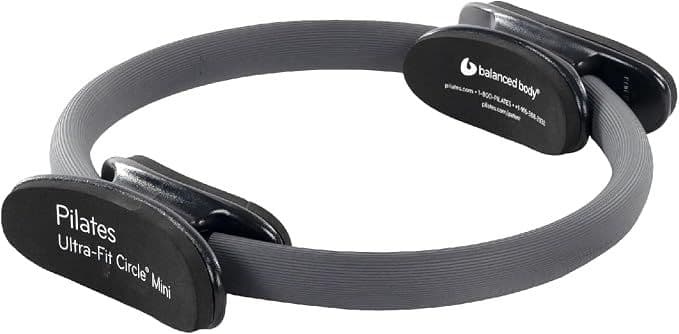
Balanced Body Ultra-Fit Circle: Studio-grade resistance ring designed for pelvic floor activation, adductor engagement, and upper-body tone.
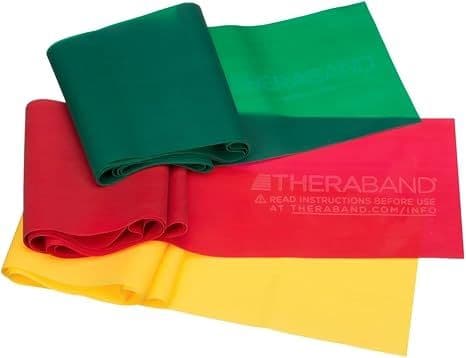
THERABAND Beginner Kit: Non-latex resistance bands with color-coded progressive tension for shoulder stability and joint support.
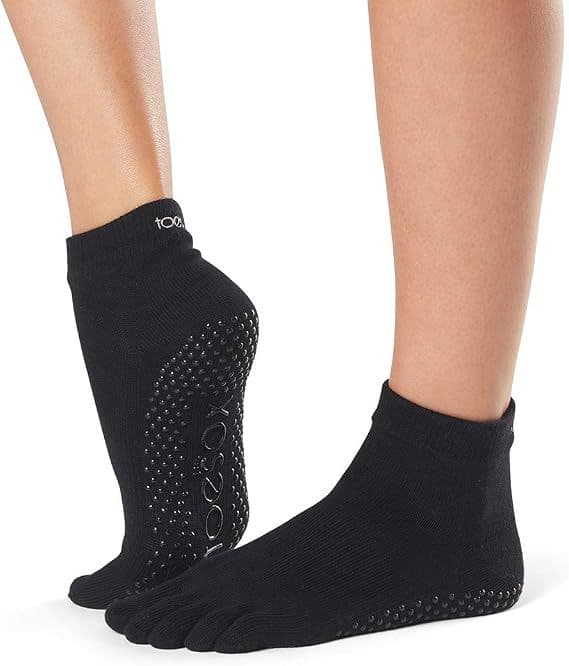
toesox Grip Full Toe Socks: Non-slip traction socks with individual toe sleeves, required across most movement studios for safety.
Disclosure: Holisteek may earn an affiliate commission from qualifying purchases through links on this page.
What happens in a reformer class?
A typical session follows a deliberate sequence that uses the machine's springs to guide your movements and deepen your body awareness.
You will move through a recognizable classical order, in seven blocks.
Step 1: Set your springs
Before the first exercise. Arrive ten minutes early so the instructor can adjust the footbar and headrest to your frame and choose the spring tension with you. Mention any injury now, before the carriage starts moving.
What it teaches: a spring is not a weight. Lighter resistance often demands more precise control from your core, and this personalized setup gives your body feedback on alignment from the very first exercise.
Step 2: Footwork
Ten minutes, lying down. Feet on the bar in four positions: toes, arches, heels and tendon stretch. You press the carriage away and control it back in, warming up the hips, knees and ankles.
What it teaches: it looks like a leg press, and it is not. The real instruction is that your pelvis and ribs stay still, holding a stable, neutral spine against moving resistance.
Step 3: The Hundred and the abdominal series
Still on your back, straight after footwork. You move into The Hundred and the abdominal series, then the arm series with the long straps, where your arms work independently of your torso.
What it teaches: deep pelvic stabilization. When you curl up holding the straps, the spring tension helps lift you, so the work is control, not strain.
Step 4: Long stretch series
The middle of the class, up on the carriage. You hold your body long and steady while the carriage glides under you, moving it with control rather than momentum.
What it teaches: continuous core bracing against an unstable, gliding surface, the demand the comparison table above describes.
Step 5: Short box
Seated on the box on top of the carriage. You articulate the spine in all directions: rounding, extending, bending to the side and rotating.
What it teaches: spinal articulation and balance against the moving carriage, without relying on the footbar for support.
Step 6: Feet in straps
Back to lying down, with your feet in the straps. Leg circles and hamstring presses open tight hips and stretch the posterior chain.
What it teaches: constant pelvic control. Your legs travel through wide circles while your pelvis stays quiet on the carriage.
Step 7: Close with stretch
The final moments of the session. Knee stretches and running come first, then the mermaid stretch and dynamic stretching expand your range of motion.
What it teaches: the feeling of length and ease that you carry with you when you step off the machine.
Mat Pilates in Brief
Mat Pilates represents the foundational root of the classical system, requiring zero apparatus beyond a supportive surface.
Practitioners utilize body weight as primary resistance, demanding strict mental focus to recruit deep stabilizing muscles without mechanical assistance.
Movement sequences focus on spinal articulation, pelvic stability, and muscular endurance. Because the floor offers no pushback or carriage glide, every millimeter of control originates entirely within the body.
What the Research Says
Clinical studies regularly examine the physiological outcomes of apparatus-based versus floor-based conditioning.
Research published in clinical sports rehabilitation journals suggests that spring resistance may support joint stability and spinal decompression more effectively during early rehabilitation phases.
Meanwhile, comparative trials indicate that both mat and reformer methods show significant improvements in abdominal muscle thickness, balance, and lumbar spine posture over multi-week protocols.
Why people try reformer pilates
The appeal usually begins with a search for deeper core engagement. The moving carriage and spring resistance demand stability from the deepest abdominal muscles, supporting better spinal alignment with every exercise.
Many students notice improved posture in daily life, often for the first time experiencing targeted core activation.
A spring is not a weight. It can assist movement just as easily as it resists it. Pushing the carriage away against heavy springs is harder, but curling up while holding the straps becomes easier because the spring tension actually pulls you up.
That mechanical quirk explains why lowering spring tension is often the advanced progression, prompting collective groans across the studio. Lighter springs remove external support and force your deep stabilizers to do every bit of the work alone.
This external support also makes it a safe entry point for recovery. The low-impact, adjustable load helps many people move gently after injury, under professional supervision, without stressing joints.
Beyond the physical, the focused breathwork often brings mental clarity and a deeper mind-body connection that keeps practitioners returning.
Your first class: what to expect
Walking into a studio for the first time, the machine looks complex, but a certified instructor calibrates every setting to your body.
Classes typically open with footwork on the bar, which warms up the hips, knees, and ankles while teaching you to maintain a stable, neutral spine against moving resistance.
From there, you transition into supine abdominal work and arm series using the long straps, training deep pelvic stabilization as your arms move independently of your torso.
Next comes feet-in-straps, where leg circles and hamstring presses open tight hips and stretch the posterior chain while demanding constant pelvic control.
The sequence progresses to seated or kneeling exercises, such as chest expansion or gentle spinal rotation, challenging balance against the moving carriage without relying on the footbar.
Sessions conclude with standing lunges or targeted stretches on the carriage, which build single-leg stability, release the hip flexors, and reinforce upright postural alignment.
Practical steps make the entry smooth. Wear form-fitting clothes, because loose garments can catch in the springs and carriage rails, and bring grip socks, which most studios require.
Arrive ten minutes early so the instructor can adjust the footbar and headrest to your frame and review your history. Always disclose any injuries before the carriage starts moving. Those with acute spine issues or recent surgery should consult a doctor first.
From the precision of the reformer carriage to the calm of a well-designed studio, every detail shapes your practice. The machine teaches alignment, but true growth happens when you find a space that reflects your intentions.
Discover your next movement practice at holisteek.com/places or browse essentials at holisteek.com/shop.
Is Reformer Pilates Right for Your Fitness Goals
Head-to-head research shows that machine workouts do not automatically outperform floor practice. A single-blind randomized controlled trial by Caglayan et al. (Reumatología Clínica, 2022) tested this directly in 28 women with fibromyalgia.
Participants completed twice-weekly supervised reformer sessions for six weeks, while the comparison group followed the same exercise program on a home mat. Both groups showed clear improvements across all measured outcomes.
Crucially, researchers found no statistically significant differences between the reformer and mat groups. While this was a small trial focused on one specific health condition, claiming that the reformer is categorically superior goes beyond current evidence.
Frequently asked questions
Get More Wellness Inspiration
Join our community of seekers. Bi-weekly dispatches on holistic science, sustainable living, and hidden wellness gems.

Leila Stanton
Editorial strategist and culture writer covering modern rituals, recovery habits, and the way wellness shapes fashion, travel, and lifestyle stories.
Related Articles
How to Choose the Best Meditation Cushion for Comfort and Posture

The 5 Best Books on Transcendental Meditation to Transform Your Practice
Lymphatic Drainage Massage: 60-Minute Sessions vs. Regular Massage

Why You Need a Shadow Work Journal
Singing Bowl Guide: Four Questions to Find Your First Bowl

Journal Prompts: 20 Thoughtful Questions for a More Intentional Writing Practice

Forest Bathing: What It Is, How to Try It in 3 Steps, and What to Expect